What is a Counterparty Asset?
Counterparty Assets (also known as Tokens, Coins, Cards or even NFT’s) are user-created tokens that are stored on the Bitcoin blockchain using Counterparty technology.
All Counterparty addresses are also regular Bitcoin addresses. You can store BTC, XCP, and user created assets on any Legacy, Segwit or Taproot Bitcoin address (provided you use a compatible Counterparty Wallet).
You can also represent user created tokens with advanced Enhanced Asset Information that include choosing any type of metadata you would like to link to the token. This includes websites, images, videos, on-chain data, music, social media and much more.
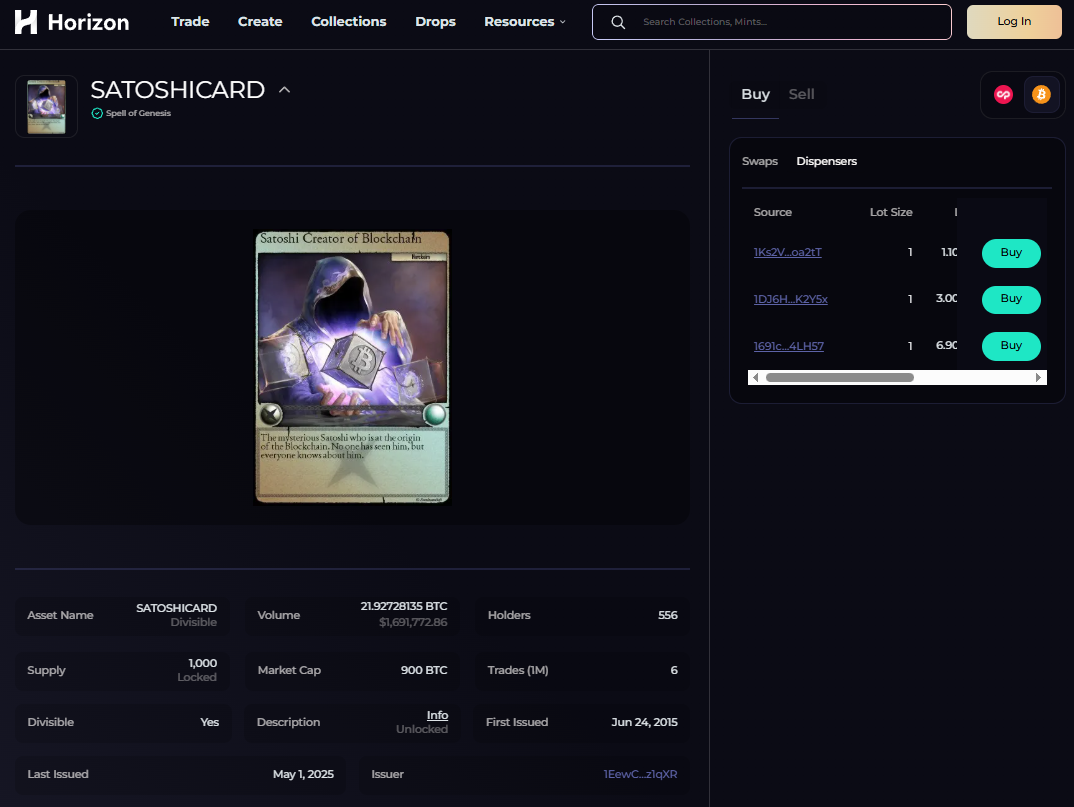
Below is an example asset, SATOSHICARD, that uses the Enhanced Asset Information schema to represent this specific artwork with an on-chain Ordinal as designated in the description field. This card also holds great significance as it was the oldest 'tokenized metaverse asset' on the Counterparty protocol. It was used in the Spells of Genesis game as well as Sarutobi. This example is shown from the Horizon Marketplace.
Anyone can create their own Counterparty Assets, so it is incredibly important to practice due diligence before engaging with the decentralized Counterparty functionalities.
Any cryptocurrencies other than Bitcoin that have their own blockchain are not supported as Counterparty only uses the Bitcoin blockchain to broadcast blockchain data. Any other blockchain is separate from the Bitcoin blockchain and thus entirely separate from Counterparty, XCP and Counterparty Assets.
How can I store Counterparty Assets?
To “store” these assets, simply send them or have them sent to your new Counterparty address made with a supported Counterparty Wallet.
If you are receiving XCP or any Counterparty asset to your address, the process is the same with BTC. Simply receive the asset (using a Counterparty Recommended Wallet) with the receiving Bitcoin address generated by your wallet.
If the Counterparty token has already been sent. You can look up your public Counterparty (Bitcoin) address on a Counterparty Block Explorer to see all functions happening on your address.
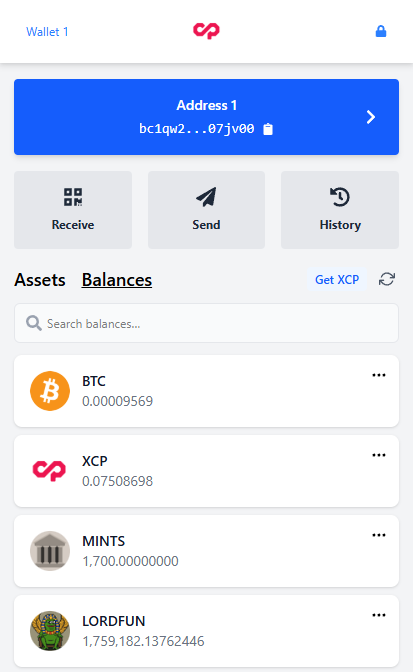
Below is an example of how the XCP Wallet looks like when you are holding BTC, XCP and other Counterparty Assets.
What is a Counterparty Named Asset?
Named Assets on Counterparty are one-of-a-kind assets set in stone.
It is most similar to how purchasing a domain name is. There is only one domain name with those exact letters, and in Counterparty there is only one possible Named asset with those exact letters. For example the token "PARTY" is considered to be 'Named' or also called 'Alphabetical'.
This is quite different for example for blockchains like Ethereum or Solana where an infinite number of contract addresses can take a specific 'name' or 'domain' to represent it. On Counterparty, the name for the Named Asset is the asset itself.
Keep in mind there are a few specifications for Named Assets:
- Named Assets must be between 4 and 12 uppercase letters and cannot start with A.
- To create an alphabetical token, you will need enough BTC for a transaction fee
- And you will also need 0.5 XCP on the address you are using to issue the Named Asset. This is an anti-spam fee, which aims to reduce the amount of names a single individual can register without significant costs. The anti-spam fee uses the XCP token and is burned (destroyed).
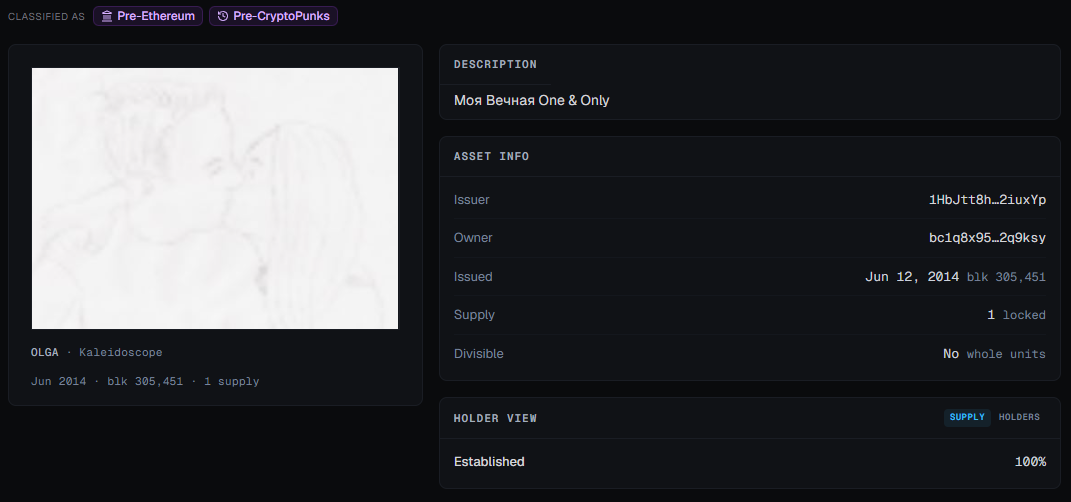
Below (as shown from xcp.io) is one of the most historic Named Assets on Counterparty: OLGA. It was the first to be a locked 1/1 non-divisible named asset on Counterparty. Extra metadata was also added on later through the Counterparty Broadcast function in base64 format. Learn more about OLGA on JPJA's website.
What is a Counterparty Numeric Asset?
Numeric Assets do not require XCP to create. Instead of a 'name' the asset starts with the letter "A" and is given a random string of numbers to define it. No two numeric asset numbers will be the same (so even Numeric assets are unique).
Numeric (or more precisely alphanumeric) tokens (for example A12149713090358620000) are free to register and only require a Bitcoin transaction fee.
- If you only want to create and trade numeric tokens, you will not require any XCP.
- Numeric tokens must start with an "A".
- You cannot choose the specific number the Numeric asset will be
In the early days of Counterparty these assets were used to test functionality before issuing a named asset.
Since then projects like Kevin McCoy's 'Silicon Flats' (A1028163271339900500) , Weex's '12 Digital Asset Backed Artworks' and even the STAMPS projects have used numeric assets in completely new ways than they were 'originally intended for'.
Numeric Assets are also used now in the newly released Counterparty Liquidity Pools. In this usage, Numeric Assets are used to represent ownership of LP tokens within a particular trading pair.
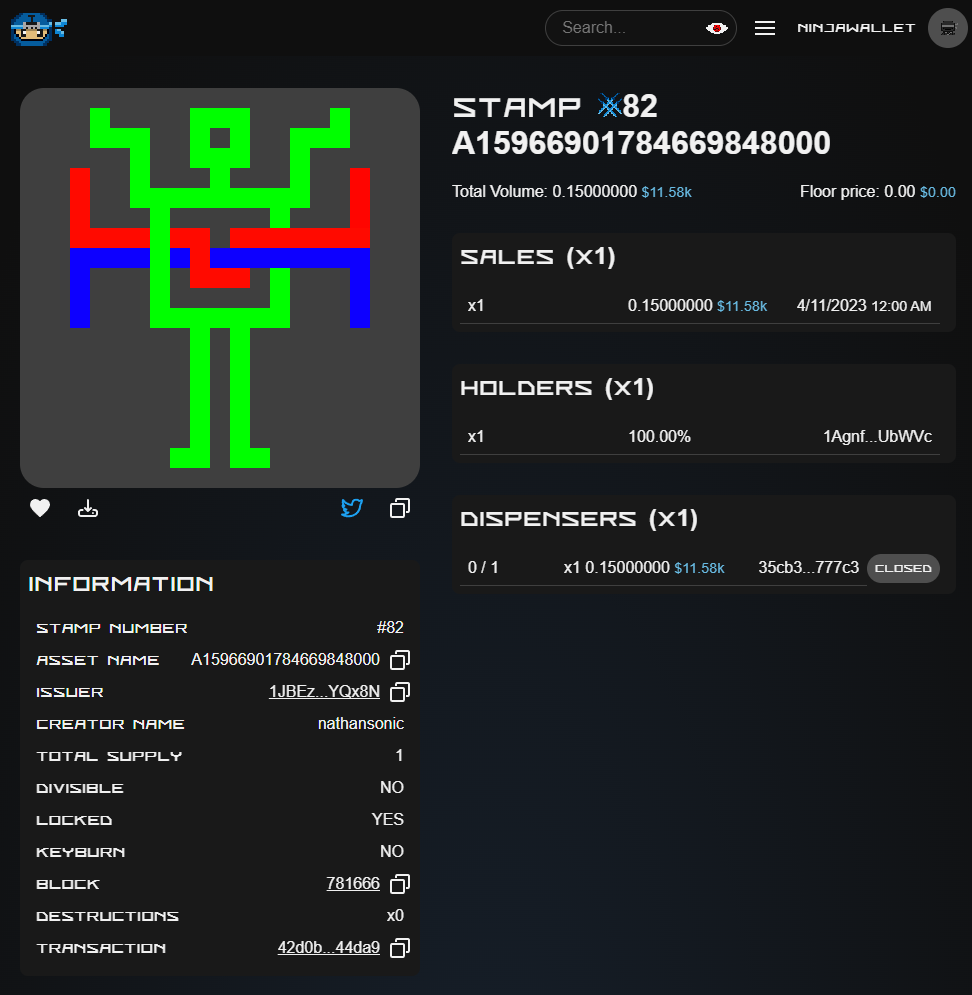
Below is a great example of a user created Numeric Asset as shown on the stamped.ninja block explorer / marketplace that also uses on-chain image information. It is STAMP #82, also known as the asset A15966901784669848000.
What is a Counterparty Subasset?
Subasset Tokens (for example PARTY.FUN or A12149713090358620000.ExampleNumericSubasset) are also considered to be unique Counterparty Assets.
These are similar in theory to 'parent-child' assets using the Ordinals protocol, but predate the creation of ordinals by almost 10 years. These can only be issued by the address that owns the prior Named or Numeric token it is a subasset to (also known as the Token Ownership holder).
- Subassets will always start with the parent named or numeric asset then have a
.before the subasset name. - Subassets can start with the letter "A"
- The full
PARENT.subassetname must be between 1 and 250 characters (a-z,A-Z,0-9, and. - _ @ !) - You must have the 'Token Ownership' of the original Named Asset or Numeric Asset first
- Subasset Tokens (on a protocol level) are also represented as Numeric Asset strings
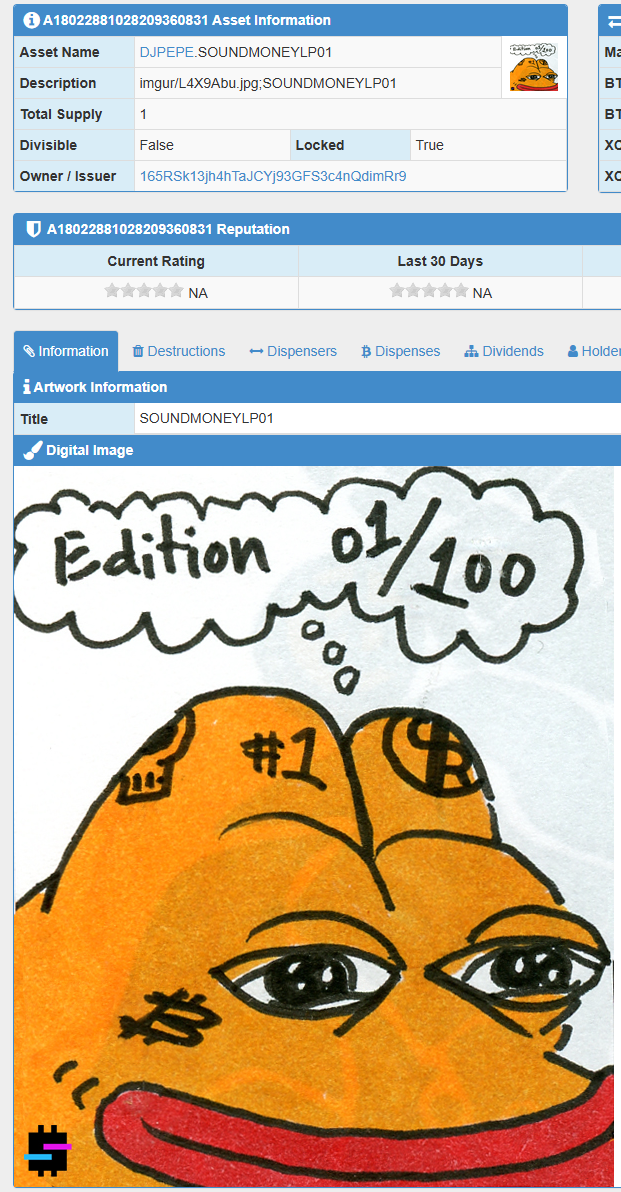
A great example of a subasset is the token representation of a physical musical album 'Sound Money' by Scrilla. DJPEPE.SOUNDMONEYLP01 is a subasset of the Named Asset 'DJPEPE' from the Rare Pepe Directory, but the subasset itself is a locked 1/1 token with corresponding art on the blockchain and in real life (physical musical album).
The example below is from tokenscan.io and as mentioned prior, Subassets on a protocol level are also represented as Numeric strings, so try not to get confused that A18022881028209360831 is also DJPEPE.SOUNDMONEYLP01
What is Token Issuance Ownership?
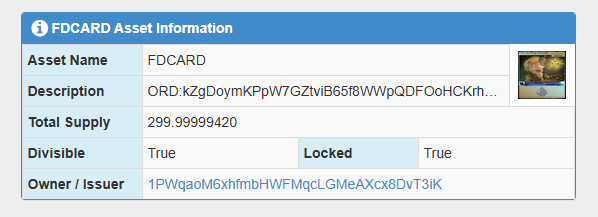
Token Ownership is automatically granted to the address that first issued a Counterparty asset (Named or Numeric).
This is shown on Counterparty Block Explorers as the "Owner / Issuer" of any particular asset:
Token Ownership grants the issuer the rights to:
- Change the Token Description
- Issue Subassets
- Issue Dividends to holders of that specific asset
- Lock
- Reset Token Supply (if Issuer holds entire supply and token is unlocked)
This should not be confused with addresses or individuals who just 'hold' or have 'purchased' this asset. Holders or purchasers of the asset itself do not have access to 'Token Ownership' and the various features that Token Issuance Ownership provides.
Though keep in mind, Token Ownership is transferable through a 'manual Token Ownership send' and even through the Sweep function. At this time, Token Ownership cannot be traded on the Counterparty Decentralized Exchange, Dispensers or Atomic Swaps.
Though keep in mind, upgrading the protocol to allow trading this ownership in a decentralized fashion is currently in discussion.
I want to trade a certain Asset, is it legitimate?
Assets/tokens are issued on the Bitcoin blockchain directly.
This means that anyone with access to the internet is able to create and trade tokens freely without restrictions.
There is no way to block Bitcoin addresses and transactions, which means that there is also no way to limit any Counterparty activity. We recommend significant due diligence and research before trading.
The example below (from the Tokenscan Counterparty Block Explorer) is the starting line for verifying at least the Counterparty data of an asset:
- Highlighted with a red box, verify that this token has a Locked Supply (most collections require this).
- Highlighted with the green box, verify that the Total Supply is the number you expect it to be
- Check the Asset Name, verify it is the EXACT Asset Name you are looking to trade.
- Shown below in the Purple box, some Counterparty Block Explorers will organize official collections and note this asset was an accepted submission into that collection. This can look different on other explorers or not be categorized at all.
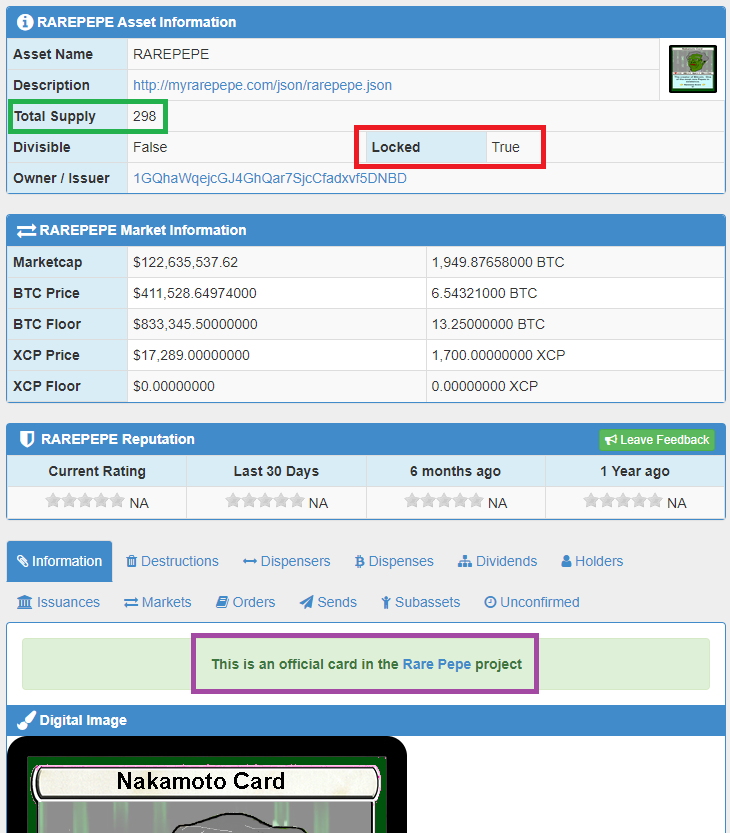
Make sure to verify not just this information provided but as much as you can before you trade.
If you are new to all of this it is recommended to review the Counterparty Github and even the archived forums for a better understanding of the Counterparty ecosystem.
To learn more about types of Counterparty assets, check out the advanced explanation for Counterparty Assets.